Introduction: The UAE Is One of the most attractive investment locations in the world.
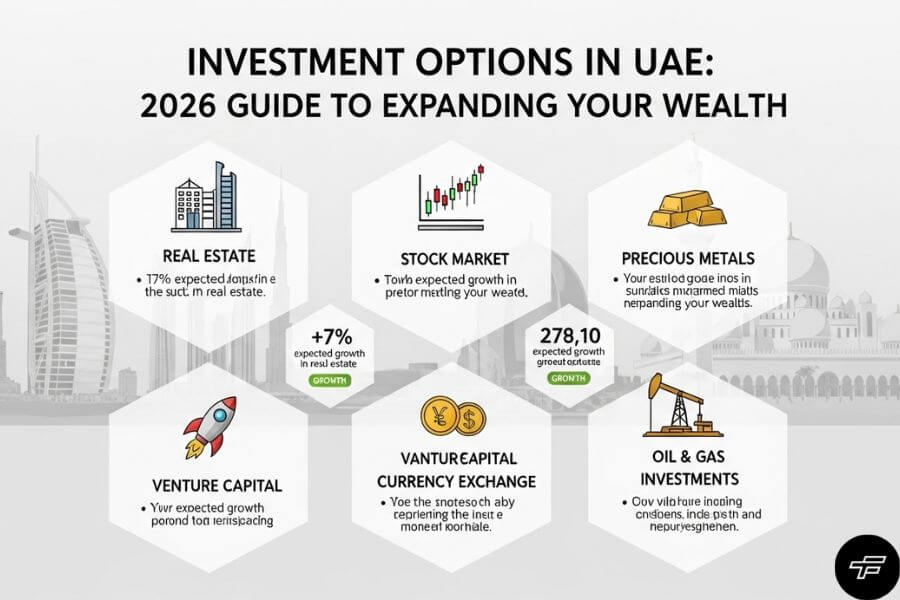
So you may be asking yourself where to invest in 2026, the Emirates may be the answer. Investment Options in UAE have never been more varied and more available and more competitive internationally. The UAE provides a financial ecosystem that is challenging to find anywhere in the world whether you are a first-time investor or a professional reallocator of capital.
The UAE is instantly recognizable thanks to three factors: zero personal income tax, the global financial infrastructure, and an active government that welcomes foreign investments. The UAE investment opportunities run the gamut of the stock market UAE and its busy trading floors, to the off-plan real estate investment UAE in developing areas, and the fast-evolving digital asset realm.
However, there is the crux of the matter that most investors will encounter: the options available are just too many. What is your risk appetite asset? What are your approaches to local regulations? And what do you start with? This guide is a slice through the noise. You will be able to make informed and smart investment choices in the UAE in 2026 by the end of your reading.
The UAE Investment Landscape: Snap On.
The financial market in the UAE has evolved tremendously in the last 10 years. In 2023 alone, Dubai alone received more than AED 31 billion in foreign direct investment, and the figure has been increasing ever since. The country has become a global capital magnet due to the government Vision 2031 and other free zone expansions.
The UAE is structurally appealing to investors in the following ways:
- Investment returns are taxed with zero capital gains tax and personal income tax.
- Two large regulated stock markets: Abu Dhabi Securities Exchange (ADX) and Dubai Financial Market (DFM).
- A booming real estate sector based on a long-term visa scheme and a boom in demand.
- A properly managed forex and derivatives market by the Dubai Financial Services Authority (DFSA).
- An emerging mutual funds market with both Shariah compliant and conventional funds.
Comparison Chart Investment Choices.
The table below provides you with a side-by-side view of the key asset classes that investors in the UAE can invest in:
| Investment Type | Min. Entry | Risk Level | Avg. Return | Liquidity |
| Real Estate (Dubai) | AED 300K+ | Medium | 6–10% p.a. | Low |
| ADX/DFM, the UAE Stock Market | AED 500+ | Medium-High | 8–15% p.a. | High |
| Mutual Funds UAE | AED 5,000+ | Low-Medium | 5–12% p.a. | Medium |
| Forex Trading (Dubai) | AED 500+ | Very High | Variable | Very High |
| Fixed Deposits (UAE Banks) | AED 10,000+ | Very Low | 2–4% p.a. | Medium |
| Gold (DGCX) | AED 1,000+ | Medium | 5–8% p.a. | High |
Note: The returns are approximate historical averages. Previous performance is not a certainty of future performance. Never make an investment without due diligence.
The Investment in Real Estate UAE: The Investment Class that Everybody is Speaking about — Because of a Reason.
The real estate investment UAE is perhaps the first thing that would come to mind when people consider investing in this country, and they would be quite right. The property market in Dubai has been in excess of expectations. Over 133,000 real estate deals were registered in Dubai in 2023, the highest in history. Prices in such prime locations as Palm Jumeirah, Downtown Dubai, and Dubai Hills Estate increased by 12–18% in 2024.
Real Estate Investments in UAE.
The participation in the UAE property market can be done in several ways:
- Off-plan properties: Directly purchased at pre-construction prices. Home builders such as Emaar, DAMAC, and Aldar have flexible payment schemes — even as low as 5 percent down. Large upside, but subject to project completion risk.
- Ready properties: Instantly rentable. Produces rental income at first. Prime Dubai property has a rental income of 5–8% per annum.
- Real Estate Investment Trusts (REITs): REITs are recommended to people who desire to have exposure to properties without holding a physical property. The Emirates REIT and ENBD REIT are traded on the Nasdaq Dubai.
- Commercial real estate: Multinational tenants have a high demand for office areas and warehouses that are located in free zones such as JAFZA and DAFZA.
Who is Making Money in Dubai Real Estate?
An example is a British expat who bought a two-bedroom apartment in Business Bay in early 2020 at AED 1.2 million. By mid 2024, similar units within the building were priced at AED 1.85 million. Together with four years of rental revenue of an average of AED 85,000 per year, his overall investment returned more than 85% over a period of four years. This is the type of performance that continues to make real estate investment UAE the first on the list of most investors.
What You Need to Get Started.
- Non-citizens are allowed to purchase real estate within special freehold areas (Dubai Marina, Downtown, JVC, and others).
- Documents needed: passport, evidence of funds and a No Objection Certificate (NOC) issued by the developer to resell.
- Registration fee at DLD (Dubai Land Department): 4% of the value of the property.
- Think about enlisting the services of a certified real estate agent with RERA.
ADX and DFM Investment in the Stock Market UAE.
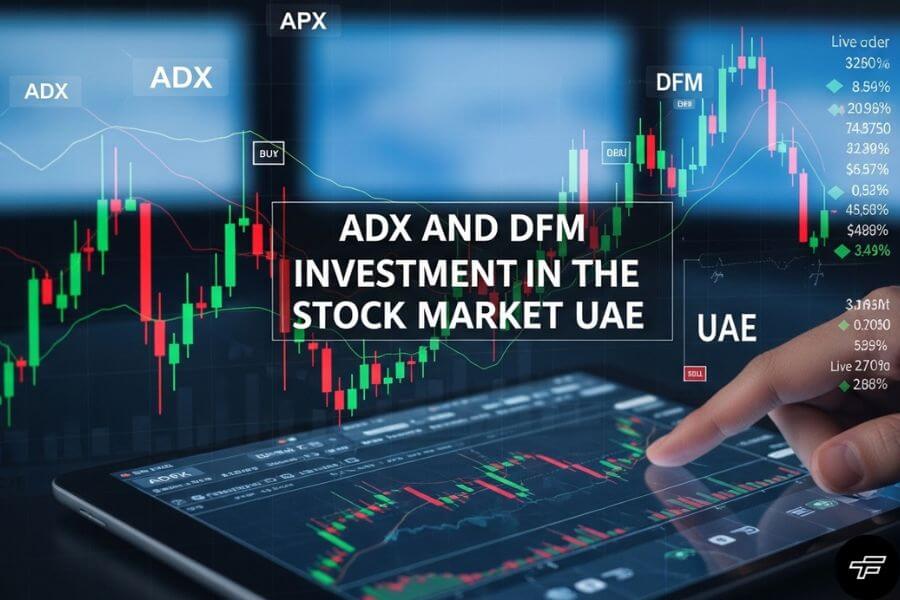
The stock market UAE consists of two major exchanges, which include the Abu Dhabi Securities Exchange (ADX) and the Dubai Financial Market (DFM). The two of them combine more than 200 companies in various industries such as banking, energy, real estate, and telecommunication. ADX alone boasts of a market capitalization of over AED 2.4 trillion, thus making it one of the largest exchanges in the MENA region.
The most important stocks that will be observed by the investors in 2026.
- First Abu Dhabi Bank (FAB): The largest bank in the UAE in terms of assets. Regular dividends and unchanging fundamentals.
- Emaar Properties (DFM): The developer of Downtown Dubai. Closely connected with the health of the property market in the UAE.
- ADNOC Distribution (ADX): Dividend-rich fuel retail chain, supported by the sovereign wealth of Abu Dhabi.
- Emirates Telecommunications (e&): This used to be Etisalat. A major telecom that has increasing African and Asian presence.
Opening an account in the UAE stock market.
The following step-by-step guide is used to get started:
- Select a licensed broker in the UAE like Emirates NBD Securities, Mashreq Securities, or Al Ramz.
- Provide your residing Emirates ID (residents) or passport (non-residents), address documents, and bank information.
- Register Investor Number (NIN) via the exchange portal.
- Top up your account and order your first online or through the app of the broker.
- Begin with blue-chip stocks and get more and more diversified as you get acquainted with the rhythm of the market.
The UAE stock exchange works on Sundays to Thursdays, in line with the Muslim week. The trading time is usually 10:00 AM to 3:00 PM UAE time. Transactions are cheap — DFM pays a 0.25 percentage fee and hence it is not expensive to trade regularly.
Mutual Funds UAE: The Smarter Way to invest without Expert Opinion.
Everyone is not able to find the time or know-how to choose stocks on a case-by-case basis, or to run a property. It is where the mutual funds UAE guide comes in as a read. A mutual fund is an investment that involves a number of investors pooling their funds and investing them in a diversified portfolio under professional management. Mutual funds in the UAE are controlled by the Securities and Commodities Authority (SCA) and have to adhere to stringent disclosure standards.
There are certain types of mutual funds that are available in the UAE.
- Equity funds: Invest mainly in stocks on the ADX, DFM or regional markets. Increased potential of returns, increased volatility.
- Fixed income funds: Invest in corporate and government bonds. Lower volatility, ideal to be kept by risk-averse investors.
- Balanced funds: A combination of bonds and equities. Appropriate to medium risk profiles.
- Shariah-compliant funds: Invested in a way that is organized on Islamic finance principles. No debts, no investment in prohibited industries.
- International feeder funds: UAE domiciled funds which invest in international indices such as the S&P 500 or MSCI World through big fund houses.
Best Fund Houses in UAE.
A number of well-known organisations have mutual fund products locally:
- Emirates NBD Asset Management.
- Franklin Templeton (office in UAE)
- Fidelity International
- BlackRock (through operations in DIFC)
- National Bonds Corporation (Shariah-compliant savings)
The major strength of the mutual funds UAE guide strategy is low entry point diversification. Most of the funds have a minimum start of AED 5,000 and permit systematic investment plans (SIPs) of AED 500 per month. It is one of the least risk-adjusted methods to engage in market growth without having an in-depth technical understanding, which is likely to be of interest to someone who is only beginning his or her investment journey.
Forex Trading Legal Dubai: Before You Start.
Whether forex trading legal Dubai is a question that is raised every minute, particularly when novice investors are attracted by tales of huge profits. The simple answer is yes — the trading of forex is legal in Dubai and the UAE, however, it is highly regulated and the trading of forex with unregulated brokers is extremely risky, both in terms of legal and financial consequences.
The Regulatory Framework.
In UAE, forex trading is governed by two major regulatory bodies:
- DFSA (Dubai Financial Services Authority): Supervises forex brokers working in the Dubai International Financial Centre (DIFC). Regarded as one of the strictest regulators worldwide.
- SCA (Securities and Commodities Authority): Regulates forex trading beyond the DIFC, and applies to the mainland of the UAE.
In case a forex broker has not been licensed by the DFSA or SCA, then they are illegally operating in the UAE. A number of UAE citizens become victims of unregulated offshore brokers, who abscond with money belonging to clients. Before committing any capital, always ensure that you check the license number of a broker on the official DFSA or SCA site.
Realistic Expectations in Trading Forex.
There is no assured flow of income in forex as social media may want to believe. Based on several reports on broker disclosure, 70–80 percent of retail forex traders lose money in a 12 months period. The successful professional traders do so after years of learning technical analysis, macroeconomics and risk management.
Forex trading legal Dubai status implies that you can use regulated trading platforms, which do not guarantee you against market losses. When you are new to forex, it is better to begin with a demo account, invest in education, and never put money into something you cannot afford to lose.
Real Life Case Study: The Story of How one Dubai Investor created a Diversified Portfolio.
Take the case of Rania, a 34-year-old Lebanese marketing manager who moved to Dubai in 2019 under a professional visa. She came with a savings amount of AED 80,000 and a need to invest in long-term wealth. The way she treated her portfolio in five years is as follows:
- 2019 – Year 1: Opened a fixed deposit of AED 20,000 with Emirates Islamic Bank at 3.2% p.a. Low risk, guaranteed yield as she became familiar with the market.
- 2020 – Year 2: Opened a DFM account and began investing AED 500/month in a diversified equity fund that invests in GCC stocks. She began in COVID, when values are discounted.
- 2021 – Year 3: Bought a 1-bed apartment in Al Furjan on an off-plan basis at AED 420,000 with a 10% down payment. The developer came up with a 60/40 payment plan — 60% at construction, 40% at handover.
- 2023 – Year 4: Given keys to the apartment. Leased it instantly under an AED 36,000 per year lease, which yields a gross rental of 8.5% on the capital invested.
- 2024–2026 – Year 5+: Property value appreciated to AED 590,000. Together with the returns on the equity funds of 11% a year, her net worth had escalated to about AED 310,000 after starting with AED 80,000.
The case of Rania explains something important; the most viable Investment Options in UAE are hardly one-time. They are a long-term, diversified approach to patients. She was not lucky. She was disciplined.
Actionable Guide: How to begin investing in the UAE today, Step-by-Step.
Step 1: Defend Your Objectives and Risk Profile.
Do you plan to save 20 years to retire or do you plan to accumulate a passive stream of income in five years? Your asset allocation is determined by your timing. Consult risk profile questionnaires that are provided by the majority of the licensed UAE banks prior to making any decisions.
Step 2: Start by Creating Your Emergency Fund.
Prior to any investment, always put at least three or six months of living expenses in a liquid, accessible account. Never spend money that you might be in urgent need of. This is no bargain for financial hygiene.
Step 3: Open right accounts.
You will need: depending on what you want to invest in:
- A UAE bank account (a basis needed in most investments)
- A stock market UAE brokerage account.
- Real estate investment UAE account with a RERA-registered agent or developer.
- A forex trading broker account that is licensed by an SCA or DFSA.
Step 4: Distribution according to Risk.
A basic outline of the UAE-based investors:
- Conservative: 60% fixed deposits/bonds, 30% mutual funds, 10% equities.
- Moderate: 40% real estate or REITs, 40% equities/mutual funds, 20% fixed income.
- Aggressive: 50% equities/forex, 30% real estate, 20% alternative assets.
Step 5: Track, Rebalance, and remain patient.
Establish a quarterly calendar of reviews. Markets move. Your assignment can be lost. Rebalancing helps to keep your portfolio on track. And most of all — do not give in to panic selling in a downturn. All the significant UAE market downturns in history have subsequently bounced back.
FAQs:
| Question | Answer |
| Which are the most suitable Investment Options in UAE to start with? | Novices may take into account mutual funds UAE guide systems such as Emirates NBD Asset Management, fixed deposits, or REITs. They have low minimums, professional management and risk that can be handled. |
| Is it legal to trade forex in Dubai? | Yes, the forex trading legal Dubai position is validated with the DFSA and SCA laws. Trade only with regulated brokers. |
| Is it possible to invest in the UAE stock market as a foreigner? | Absolutely. In the Dubai Financial Market (DFM) and the Abu Dhabi Securities Exchange (ADX), foreign investors that are not residents can open accounts and trade listed securities. |
| How much will it cost to invest in real estate in Dubai? | UAE entry points to real estate investment are varied. Emerging regions such as the Dubai South properties under off-plan begin at AED 300,000–500,000 whereas prime areas start at AED 1 million+. |
| Are the returns on investments taxed in the UAE? | The UAE does not currently levy personal income or capital gains tax on the investment returns of individuals, and so it is very appealing to international investors. |
| What is the process of opening a brokerage account with the UAE stock market? | Go to a licensed broker, licensed by DFSA or SCA. You will be required to have your Emirates ID or passport, address proof, and a bank account. It is done within 2–5 business days. |
| What are the risks of mutual funds in UAE? | Mutual funds UAE lead the investors to learn risks such as market volatility, currency exposure and fund manager risk. Always examine the fund fact sheet and its performance. |
| Will Dubai real estate be a good investment in 2026? | Dubai real estate has performed better than most of the world markets. It continues to be a robust medium-to-long-term investment with Expo 2020 legacy projects continuing to drive demand and zero property tax. |
| What is the DFSA? | DIFC has an independent financial regulator of the Dubai Financial Services Authority (DFSA). It controls forex brokers, investment firms, and fund managers in the free zone. |
| Is it possible to invest in the UAE as a tourist or non-resident? | UAE stock markets and limited real estate can be invested by non-residents. But to open a bank account, residency is normally a requirement. International accounts can be used to trade stocks by some brokers. |
Conclusion:
The UAE 2026 is not only a destination to live and work, it is one of the most attractive destinations of the world to create real and sustainable wealth. Whether it is the constantly changing nature of Investment Options in UAE terrain or the minutiae of the asset classes in your portfolio or fund, this guide has sought to provide you with the insight, understanding, and the courage to act.
Be it the real-life aspect of real estate investment UAE, the expansion prospects of stock market UAE, the professional management of mutual funds UAE, or the risk and potential of forex trading legal Dubai, in the right knowledge and expectations, each avenue is worth pursuing.
Those who repeatedly emerge victorious in the UAE are not people who jump on the trendiest bandwagon. It is them that create diversified portfolios, learn their risk, are patient in market cycles, and continue to learn. Begin where thou art. Use what you have. And leave the rest to be done by the extraordinary financial environment of the UAE.
Need answers to starting? You should seek advice with a licensed financial advisor (DFSA or SCA).