The digital world never sleeps. Neither do cyber threats.
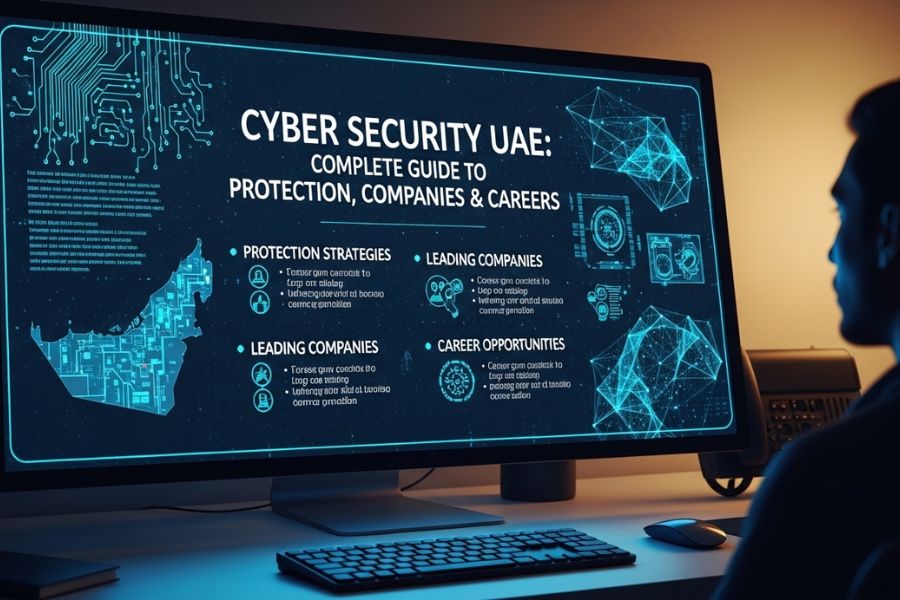
In the UAE, businesses face thousands of cyber attacks every single day. Banks. Hospitals. Government offices. Schools. Even small shops.Nobody is safe anymore.But here’s the good news. The UAE takes cyber security seriously. Really seriously. Dubai and Abu Dhabi have become regional leaders in digital protection. The government invests billions. Companies hire top talent. New regulations protect data. If you’re curious about cyber security UAE, you’re in the right place. This guide covers everything. What it is. Why it matters. Who provides it. And how you can get involved.
Let’s explore the world of cybersecurity in the Emirates.
Understanding Cyber Security in UAE
Cyber security means protecting computers, networks, and data from attacks. Simple definition. Complex reality.
The UAE’s digital transformation happened fast. Very fast.In just 20 years, the country went from basic internet access to smart cities. Dubai has smart police stations. Abu Dhabi runs smart traffic systems. Everything connects online.
This creates opportunities. But also vulnerabilities.
Why UAE Needs Strong Cyber Security
The numbers tell the story:
Financial sector risks. UAE banks handle billions in transactions daily. One successful attack could crash the economy.
Critical infrastructure. Power grids, water systems, and airports all run on digital networks. A cyber attack could shut down entire cities.
Government services. Most government services are now online. Citizen data needs protection.
Business operations. Over 90% of UAE companies depend on digital systems. Downtime costs millions.
Personal data. Millions of residents share personal information online daily. Privacy matters.The UAE government recognized these risks early. They created comprehensive strategies to address them.
National Cyber Security Strategy
The UAE launched its National Cyber Security Strategy in 2019. The goals are clear:
Build a safe digital infrastructure. Protect critical systems. Create a strong regulatory framework. Develop local cyber security talent.This strategy transformed how the country approaches digital threats. It coordinates efforts across government, military, and private sectors.Results show progress. The UAE now ranks among the top 5 globally in cyber security readiness.
Top Cyber Security Companies in UAE
The UAE’s demand for digital protection created a booming industry. Dozens of cyber security companies operate across Dubai, Abu Dhabi, and other emirates. Some are international giants with regional offices. Others are homegrown UAE companies that understand the local landscape intimately.
International firms bring global expertise to the Emirates. Companies like Cisco, IBM Security, and Fortinet maintain strong presences in Dubai and Abu Dhabi. They serve large enterprises, government entities, and critical infrastructure with services including threat monitoring, incident response, security audits, and compliance consulting. These firms have worked with governments worldwide and understand complex, sophisticated threats.
Regional cyber security specialists focus specifically on the Middle East market. These companies understand UAE regulations better than anyone. They know Arabic. They navigate local business practices smoothly. They provide more personalized service and respond quickly when problems arise. Many have built long-term relationships with UAE businesses and government departments.
Local Dubai-based cyber security providers know the Emirates’ landscape intimately. They understand local threats, have direct connections with UAE authorities, and can mobilize resources immediately. Many started as small ventures but grew into serious industry players. They hire Emirati talent, train local specialists, and actively contribute to the national cyber security strategy.
These companies offer comprehensive cyber security solutions including network security to protect digital infrastructure with firewalls and intrusion detection systems. They provide cloud security for data stored in AWS, Azure, and other platforms. Endpoint protection safeguards individual devices from computers to IoT sensors. Many operate 24/7 Security Operations Centers that monitor networks in real-time, detecting and responding to threats instantly. They conduct penetration testing to find vulnerabilities before criminals do, provide rapid incident response when attacks occur, help businesses meet UAE cyber security regulations, and train employees to recognize threats.
When choosing a cyber security company in Dubai or anywhere in the UAE, consider their experience in your specific industry. Healthcare needs differ dramatically from banking. Retail has different requirements than the government. Look for companies with local presence who can respond quickly and understand UAE regulations thoroughly. Check for certifications like ISO 27001 and PCI DSS. Ask for references and verify their track record. Ensure their technology stack is modern and can integrate with your existing systems. Most importantly, confirm they offer 24/7 support because cyber attacks don’t respect business hours.
Cyber Security Solutions Available in UAE
Technology evolves constantly, and so do the cyber security solutions available in the Emirates. UAE businesses can access world-class protection tools that match systems used by Fortune 500 companies globally. The variety of solutions reflects the country’s commitment to staying ahead of digital threats.
Essential security solutions form the foundation of protection for UAE organizations. Email security stops phishing attacks and malicious attachments that target Dubai businesses daily. Web filtering blocks access to dangerous websites and prevents malware downloads while controlling employee internet usage. Data loss prevention systems stop sensitive information from leaving your network, preventing both accidental and intentional data leaks. Mobile device management secures smartphones and tablets, which are everywhere in the UAE’s mobile-first society. Identity and access management controls who can access what, using multi-factor authentication and password management. Security information and event management systems collect and analyze security data from across networks, identifying patterns and detecting threats. Backup and disaster recovery solutions protect against ransomware and data loss while ensuring business continuity after attacks.
Emerging technologies are transforming cyber security in the UAE. Artificial intelligence-powered tools detect threats faster than humans possibly can. They learn from patterns and predict attacks before they happen. The UAE invests heavily in AI security as part of its national AI strategy. Blockchain technology creates tamper-proof records useful for financial transactions and supply chain tracking, particularly relevant for Dubai’s trading hub status. Zero trust architecture operates on a “never trust, always verify” principle where every access request gets authenticated even inside your network. Extended detection and response integrates security across endpoints, networks, and cloud environments, providing unified visibility and response capabilities that UAE enterprises increasingly adopt.
Different industries in the UAE need different approaches. Banking and finance sectors focus on transaction security, fraud detection, and regulatory compliance with strict UAE Central Bank requirements. Healthcare organizations protect patient records, secure medical devices, and comply with health data regulations. Government entities defend critical infrastructure, protect citizen data, and maintain service availability. Retail businesses secure payment systems, protect customer data, and prevent point-of-sale compromises. The oil and gas sector protects operational technology, secures remote facilities across the Emirates, and defends against nation-state attacks. Education institutions safeguard student data, secure research, and protect online learning platforms that expanded dramatically across the UAE.
Cyber Security Courses in Dubai
Dubai offers excellent training opportunities for anyone wanting to work in cyber security. The UAE actively develops local talent through universities, training centers, and online platforms that provide education at all levels. This investment in human capital reflects the country’s understanding that technology alone isn’t enough – skilled professionals make the difference.
Several UAE universities offer cyber security degrees at both undergraduate and graduate levels. These programs cover networking fundamentals, cryptography, ethical hacking, digital forensics, and security management. Graduates earn internationally recognized qualifications, and many find jobs before completing their degrees due to high demand. Universities in Dubai, Abu Dhabi, and Sharjah compete to offer the best programs.
Industry certifications prove your skills and employers value them highly. Popular certifications available through cyber security courses in Dubai include Certified Information Systems Security Professional (CISSP), Certified Ethical Hacker (CEH), CompTIA Security+, Certified Information Security Manager (CISM), and Offensive Security Certified Professional (OSCP). Training centers across Dubai prepare students for these exams. Some offer intensive boot camps while others provide evening classes for working professionals who want to advance their careers without leaving their current jobs.
Specialized training addresses specific needs in the UAE market. Penetration testing courses teach you to hack legally, find vulnerabilities, and help companies fix weaknesses. Incident response training masters the art of responding to attacks, containing damage, investigating breaches, and recovering systems. Cloud security courses specialize in protecting AWS, Azure, and other cloud platforms that UAE businesses increasingly adopt. OT cyber security training focuses on operational technology to protect industrial systems in manufacturing and energy facilities across the Emirates. Security operations center training teaches students to monitor networks, detect threats, and respond to incidents in real-time.
The UAE government supports cyber security education through multiple initiatives. Scholarship programs provide financial support for Emiratis pursuing cyber security studies. Training partnerships with international universities and training providers bring world-class education to the Emirates. Competitions and capture-the-flag events develop practical skills in fun, competitive environments. Internship programs at government agencies offer hands-on experience to students, giving them real-world exposure before graduation.
Online learning options exist for those who can’t attend physical classes in Dubai. International platforms like Udemy, Coursera, and Cybrary provide affordable training. Some courses are free while others cost just a few hundred dirhams. Quality varies significantly, so check reviews carefully, verify instructor credentials, and look for programs offering hands-on labs and practical exercises rather than just theory.
Career Opportunities: Cyber Security Analyst & Specialist Roles
The cyber security job market in UAE is booming. Demand exceeds supply. Companies struggle to find qualified people.
This creates opportunities. Good opportunities.
Cyber Security Analyst Positions
A cyber security analyst monitors systems for threats. They analyze security events. They investigate suspicious activity. They respond to incidents.
Typical responsibilities:
- Monitor security alerts and logs
- Investigate potential security incidents
- Conduct vulnerability assessments
- Generate security reports
- Recommend security improvements
- Stay updated on latest threats
Required skills:
- Understanding of networks and systems
- Knowledge of security tools and technologies
- Analytical thinking
- Attention to detail
- Problem-solving abilities
- Communication skills
Salary ranges in UAE: Entry-level: AED 8,000 – 12,000 per month Mid-level: AED 15,000 – 25,000 per month Senior: AED 30,000+ per month
Cyber Security Specialist Roles
Specialists focus on specific areas. They have deeper expertise in particular domains.
Types of specialists:
Network security specialist: Protects network infrastructure. Configures firewalls. Implements VPNs. Monitors network traffic.
Application security specialist: Secures software and applications. Reviews code. Conducts security testing. Works with developers.
Cloud security specialist: Protects cloud environments. Secures AWS, Azure, and Google Cloud deployments.
Forensics specialist: Investigates cyber crimes. Analyzes digital evidence. Supports law enforcement.
Governance, risk, and compliance (GRC) specialist: Ensures regulatory compliance. Manages security policies. Conducts risk assessments.
Career Progression
Cyber security careers offer clear advancement paths:
Entry level: Security analyst, junior penetration tester, SOC analyst
Mid-level: Senior analyst, security engineer, cyber security specialist
Senior level: Security architect, SOC manager, penetration testing lead
Executive level: Chief Information Security Officer (CISO), Director of Security
The UAE’s growing digital economy ensures long-term career stability. New opportunities emerge constantly.
Skills in Demand
Employers seek specific capabilities:
Technical skills:
- Penetration testing
- Security operations
- Cloud security
- Threat hunting
- Incident response
- Security architecture
- Programming (Python, PowerShell)
Soft skills:
- Communication
- Teamwork
- Problem-solving
- Continuous learning
- Business understanding
- Project management
Certifications boost employability significantly. Many companies require specific certifications for senior roles.
OT Cyber Security: Protecting Critical Infrastructure
Operational Technology (OT) differs from traditional IT. It controls physical processes and equipment.
Power plants. Water treatment facilities. Oil refineries. Manufacturing lines. All rely on OT systems.
Why OT Cyber Security Matters in UAE
The UAE’s critical infrastructure faces unique threats. Nation-state actors target energy facilities. Criminals attack industrial systems for ransom.
One successful attack could:
- Shut down power to entire cities
- Contaminate water supplies
- Halt oil production
- Stop manufacturing
- Disrupt transportation
The consequences extend beyond financial losses. Lives could be at risk.
OT Security Challenges
Securing operational technology is complex:
Legacy systems: Many industrial systems are decades old. They weren’t designed with security in mind. Updating them is difficult or impossible.
Availability requirements: OT systems can’t go offline for updates. Manufacturing runs 24/7. Power generation never stops.
Different protocols: OT uses specialized communication protocols. Traditional IT security tools don’t work.
Physical consequences: OT attacks can damage equipment or harm people. The stakes are higher than pure IT attacks.
Convergence of IT and OT: Modern facilities connect OT to corporate networks. This creates new attack paths.
OT Security Solutions
Specialized cyber security solutions address OT challenges:
Network segmentation: Isolate OT networks from IT networks. Limit attack surface. Control access points.
Industrial firewalls: Purpose-built for OT protocols. Understand industrial communications. Provide appropriate protection.
Anomaly detection: Monitor normal OT behavior. Alert when unusual activity occurs. Don’t rely on signatures alone.
Secure remote access: Enable authorized remote monitoring and control. Prevent unauthorized access.
Asset visibility: Know what devices exist on OT networks. Track configurations. Identify vulnerabilities.
Incident response plans: Specific procedures for OT incidents. Different from IT response. Consider physical safety first.
Several cyber security companies in UAE specialize in OT protection. They understand industrial environments. They work with energy, utilities, and manufacturing sectors.
Dubai Cyber Security Landscape
Dubai positions itself as a global cyber security hub. The vision is ambitious. The progress is real.
Dubai’s Cyber Security Initiatives
Dubai Electronic Security Center (DESC): Protects government digital infrastructure. Monitors threats. Coordinates incident response across government entities.
Dubai Cyber Security Strategy: Aims to make Dubai one of the safest digital cities globally. Focuses on resilience, awareness, and innovation.
Cyber Security Council: Brings together government, private sector, and academia. Coordinates national efforts. Shares threat intelligence.
Smart Dubai and Security
Dubai’s smart city initiative creates both opportunities and challenges.
Smart traffic systems. Smart buildings. Smart healthcare. Everything connects. Everything generates data.
This connectivity improves life. But it also expands the attack surface.
Dubai addresses this through:
- Security by design principles
- Regular security audits
- Continuous monitoring
- Rapid incident response capabilities
- Public-private partnerships
Business Environment
Dubai attracts cyber security companies from worldwide. The business environment is favorable:
Free zones: Offer tax benefits and foreign ownership. Dubai Internet City hosts many tech companies.
Regulatory support: Clear guidelines for cyber security services. Government supports the industry’s growth.
Regional hub: Dubai serves the entire Middle East market. Companies based here reach from North Africa to South Asia.
Investment opportunities: Venture capital flows into cyber security startups. Government funds support innovation.
Talent pool: International workforce brings diverse expertise. Growing local talent adds regional knowledge.
Regulations and Compliance in UAE
The UAE takes cyber security regulation seriously. Multiple frameworks govern different sectors.
Key Regulations
UAE Cybercrime Law: Defines cyber offenses and penalties. Covers hacking, fraud, privacy violations, and more.
Data Protection Law: Regulates how organizations collect, store, and use personal data. Similar to GDPR in many ways.
UAE Information Assurance Standards: Mandatory for government entities. Defines security requirements for systems and data.
Critical Infrastructure Protection: Special requirements for entities operating critical infrastructure.
Financial Services Regulations: Central Bank standards for banks and financial institutions. Strict security and compliance requirements.
Healthcare Data Protection: Rules governing patient information. Privacy and security requirements for medical data.
Compliance Requirements
Organizations must:
Implement appropriate security controls: Based on risk and data sensitivity.
Conduct regular assessments: Identify vulnerabilities. Test security measures. Document results.
Report incidents: Notify authorities of significant breaches. Timelines vary by regulation.
Train employees: Security awareness programs. Regular updates on threats and policies.
Maintain documentation: Security policies, procedures, and records. Prove compliance during audits.
Use licensed providers: Some services require licensed cyber security companies.
Penalties for Non-Compliance
Violations carry serious consequences:
Fines: Can reach millions of dirhams depending on severity.
Imprisonment: Cyber crimes can result in jail time.
Business closure: Serious violations may lead to license revocation.
Reputation damage: Breaches become public. Customer trust erodes. Business suffers.
Compliance isn’t optional. It’s essential for operating in UAE.
Future of Cyber Security UAE
The cyber security landscape constantly evolves. UAE adapts quickly.
Emerging Trends
Artificial Intelligence: Both attackers and defenders use AI. The arms race accelerates. UAE invests heavily in AI-powered security.
Quantum computing: Will break current encryption methods. UAE prepares for post-quantum cryptography.
5G security: Network expansion creates new vulnerabilities. Securing 5G infrastructure becomes a priority.
Internet of Things (IoT): Billions of connected devices. Each a potential entry point. UAE develops IoT security standards.
Supply chain security: Attacks target vendors and suppliers. Organizations strengthen third-party risk management.
Investment and Growth
The UAE government commits billions to cyber security:
Research and development: Funding for security innovation and new technologies.
Infrastructure: Building state-of-the-art security operations centers.
Education: Training the next generation of security professionals.
International cooperation: Partnerships with global leaders in cyber security.
The private sector matches this investment. Cyber security companies expand operations. New startups emerge. The industry grows double digits annually.
Career Outlook
Job opportunities will multiply:
Growing demand: Every organization needs cyber security. Demand far exceeds supply.
Higher salaries: Competition for talent drives compensation up.
Diverse roles: New specializations emerge constantly. Career paths expand.
Remote opportunities: Some positions allow remote work. Talent can work globally.
The UAE actively recruits international talent. It also develops local expertise through education and training programs.
Frequently Asked Questions
What is cyber security UAE and why is it important?
Cyber security UAE refers to the protection of digital systems, networks, and data in the United Arab Emirates. It’s critical because UAE has rapid digital transformation with smart cities, online government services, and digital banking. Without strong security, the country faces risks to critical infrastructure, financial systems, and personal data.
How do I choose a cyber security company in Dubai?
Look for companies with relevant industry experience, local presence, proper certifications (ISO 27001), proven track record, and 24/7 support. Check if they understand UAE regulations and can respond quickly to incidents. Ask for references and verify their technology capabilities match your needs.
What cyber security solutions do UAE businesses need most?
Most businesses need email security, firewalls, endpoint protection, backup systems, and employee training. Larger organizations add SOC monitoring, SIEM systems, and incident response services. Specific needs depend on your industry – banking needs different solutions than retail or manufacturing.
Are there good cyber security courses in Dubai?
Yes. Dubai offers university degrees, professional certifications (CISSP, CEH, Security+), and specialized training. Both local universities and international training centers operate here. Government scholarship programs support Emiratis. Online courses from Coursera and Udemy are also available.
What does a cyber security analyst do in UAE?
A cyber security analyst monitors systems for threats, investigates security incidents, conducts vulnerability assessments, and generates reports. They work in SOC environments, respond to alerts, and recommend security improvements. Salaries range from AED 8,000 for entry-level to AED 30,000+ for senior positions.
What is OT cyber security and who needs it?
OT (Operational Technology) cyber security protects industrial control systems in manufacturing, energy, water, and utilities. It differs from IT security because it controls physical processes. UAE’s critical infrastructure requires specialized OT security to prevent disruptions to power, water, and oil production.
How much do cyber security specialists earn in the UAE?
Entry-level positions start at AED 8,000-12,000 monthly. Mid-level specialists earn AED 15,000-25,000. Senior specialists and managers make AED 30,000-50,000. CISOs can earn AED 70,000+. Salaries vary by experience, certifications, industry, and company size.
What regulations must UAE companies follow for cyber security?
Companies must comply with UAE Cybercrime Law, Data Protection Law, and industry-specific regulations. Government entities follow Information Assurance Standards. Banks follow Central Bank requirements. Healthcare follows patient data protection rules. Non-compliance brings heavy fines and potential imprisonment.
Conclusion
Cyber security UAE is essential for the country’s digital future.The UAE transformed into a smart nation quickly. This created massive cyber threats. But the response has been strong.Government invests billions. Companies offer world-class solutions. Education programs train talent. Regulations protect data.For businesses, proper security isn’t optional. It’s necessary for survival.For students and professionals, cyber security offers excellent careers. High demand. Good salaries. Clear growth paths.The future is digital. And digital needs protection.Start today. Secure your business. Advance your career. Protect what matters.